

What to Know Before Choosing Fire Rebuild Methods in Los Angeles
Losing your home in a wildfire is so much more than just a construction problem. It is grief, immense loss, insurance calls, temporary housing, and pressure to make expensive, life-changing decisions while you are exhausted. If you are rebuilding in Altadena, Pacific Palisades, or Malibu you are likely working within insurance limits and timelines that do not feel generous.
With a loss like this, there is no perfect choice and no way to replace what was taken. What you can do is move step by step, with clear information, so each decision is more informed and feels a little less overwhelming. This guide is meant to reduce one specific kind of pressure: deciding how to rebuild.
We will walk through the main fire rebuild construction methods Los Angeles homeowners are actually using, what they typically cost, how they perform in fires and earthquakes, and how long they usually take. The goal is to help you align your rebuild approach with your budget, site conditions, and timeline, so the path back to your property feels more manageable.
Wildfire Rebuild Cost Considerations in Los Angeles
.jpg)
After a fire, most people hear a few price-per-square-foot numbers and are expected to make major choices around them. Those numbers are almost always incomplete.They usually cover hard costs only, which means labor and materials for the actual construction of the home itself.
Hard costs do not include soft costs, which often add another significant line to your budget and are easy to underestimate when you are already dealing with insurance and temporary housing.
Soft costs typically include things like:
- Architecture and interior design
- Structural and civil engineering
- Surveys, soils reports, and Title 24 energy reports
- other non-essential consultant costs
- Permits, utility fees, and plan check costs
- Owner allowances for appliances, fixtures, and finishes
For many rebuilds, soft costs land somewhere in the range of about $200,000 to $350,000 or more, depending on scope and agency requirements. Exact numbers vary by jurisdiction and by how complex your project is. Understanding construction costs is essential when planning a fire rebuild project, our team understands how to help families make informed decisions about budgeting, timelines, and the overall rebuilding process.
Wildfire areas are also governed by WUI-compliant construction rules, which require specific fire-resistant materials and details. These are set by the State of California and local jurisdictions and are updated as fire risk and codes evolve. Insurance payout limits, local labor conditions after recent fires, and material markets all shape what your dollars can actually build.
Across this guide, we will reference five main systems as a spectrum, from lower-cost toward maximum resilience:
- Stick-built wood framing
- ICF (insulated concrete forms)
- Modular
- Omniblock/Steel
- All-Steel Hardened
Each has different implications for cost, schedule, permitting complexity, and long-term performance in fire and earthquakes.
Where Does ICF Fit Between Value and Fire Resilience?
.avif)
ICF construction fire rebuild systems use hollow foam blocks or panels that are stacked, reinforced, and filled with concrete, forming solid walls. The foam stays in place as continuous insulation, while the concrete core typically carries a multi-hour fire rating and very good thermal performance under standard testing.
ICF hard costs often fall around $1.30 million, or roughly $530 per square foot, for a WUI-compliant home in Los Angeles County. Once you factor in all the required WUI upgrades for wood framing, ICF can be cost-competitive with stick-built and sometimes a stronger value for the resilience it provides, especially in high fire-severity zones.
ICF tends to work well if you:
- Want stronger fire-resistant home construction LA performance than wood
- Have a moderate budget but care about durability and interior comfort
- Prefer quieter, more temperature-stable interiors
The main trade-off is that some details, such as window openings and structural connections, require an experienced team. That can limit contractor options in certain submarkets and may affect bidding timelines.
What Does Stick-Built Framing Mean for Your Rebuild Budget?
.jpg)
For many homeowners, stick-built is the system they know best. Stick-built means traditional wood-framed walls and roofs built on site. In a WUI fire zone, this system must be hardened with details like fire-resistant roofing, siding, vents, and tempered glazing to meet code and improve survival chances.
For a roughly 2,455 square foot home, current Altadena fire rebuild options using stick-built framing often start in the range of about $1.41 million in hard costs, or about $573 per square foot, based on recent post-fire bids and publicly discussed cost ranges for WUI-compliant builds in Los Angeles County. Actual pricing will vary with design complexity, slopes, access, and market conditions at the time of contracting.
Stick-built can be a fit if you:
- Need to stay within tight insurance limits
- Have a relatively straightforward lot
- Want maximum design flexibility in layout and style
Trade-offs include that you are still relying on a combustible structure, even with WUI hardening, and some insurers may scrutinize wood-heavy builds more closely over time as wildfire risk and insurance models evolve. You also remain exposed to lumber price volatility. For a deeper comparison of stick-built homes versus fire-resistant construction methods like Type III CMU block and ICFs, you can read our full breakdown here: Type III CMU Block and ICFs Blog.
Can Modular Construction Help You Stay Within ALE Deadlines?
.jpg)
When you are counting months of temporary housing and watching ALE (Additional Living Expenses) benefits, speed matters as much as cost. Additional Living Expenses (ALE) coverage, often under "Loss of Use" (Coverage D) in homeowners insurance, pays for the increase in living expenses (housing, food, transportation) necessary to maintain your normal standard of living while your home is uninhabitable after a fire. It covers costs above your normal expenses, not your entire cost of living, and typically lasts until repairs are completed or a policy limit is reached.
Modular home rebuild methods rely on factory-built modules transported to your site, craned onto a permanent foundation, and stitched together. The modules typically use a steel chassis and arrive with much of the interior already finished.
For the same 2,455 square foot baseline, modular hard costs are often around $1.056 million, or about $430 per square foot, before on-site work. The real strength of modular is time. Many homeowners can move back within about 7 to 10 months from construction start, compared with roughly 12 to 18 months for most site-built methods. That time difference can be critical under ALE timeline rebuild pressure.
Modular can make sense if you:
- Need the shortest path to safe occupancy
- Have relatively easy crane access and staging room
- Are comfortable with more limited design customization
Key trade-offs include stricter site logistics, fewer layout options, and the need to read contracts closely to understand what the factory price covers versus foundation, utility work, decks, drives, and site improvements.To learn how modular construction can help homeowners rebuild faster, improve fire resilience, and better manage costs after a wildfire, explore our full guide here: Rebuilding Your Home After Wildfire via Custom Prefab and Modular Construction.
Letter Four is developing a collection of pre-designed modular homes currently in the submission process for LA County's pre-approved plans program. Pre-approved designs move through county review faster than custom plans, which matters when every week of waiting carries real weight. More designs are coming in the months ahead, giving families more options without more complexity.
How Do Omniblock/Steel, All-Steel, Fire Hardened Systems Change Risk?
.avif)
Some homeowners, especially in repeatedly impacted fire corridors, decide that higher upfront cost is worth a more hardened shell. Omniblock/Steel uses grouted concrete masonry units with steel deck framing. It is a heavy, durable system with strong fire and structural performance and low susceptibility to rot or termites.
For our baseline, Omniblock/Steel commonly runs about $1.88 million, or roughly $767 per square foot. It is a serious fire-zone option at a mid-to-high price point, especially for owners who want a long-term, low-maintenance shell and are planning to remain in the home for many years.
All-Steel Hardened uses full structural steel with noncombustible cladding to create a highly hardened envelope with strong seismic ductility. Reported hard costs for this level of structure are around $1.68 million, or about $685 per square foot, for the baseline size. This can support long-term insurability and structural performance in both wildfire and earthquakes, subject to evolving insurance underwriting.
These premium systems can be a fit if you:
- Plan to stay long-term and are focused on resilience
- Are highly concerned about fire, smoke, and mold damage
- Are prepared to accept higher upfront cost to reduce certain kinds of future repair risk
Steel often has an edge in seismic performance. Pacific Palisades rebuild cost and system choices often come down to your site conditions, local soil and slope constraints, and which risks matter most to you and your family.
How Do These Systems Compare, and What Extra Costs to Plan For?
.avif)
Here is a simplified snapshot of typical hard costs for a roughly 2,455 square foot WUI-compliant home, based on recent post-fire rebuild ranges discussed in the Los Angeles market:
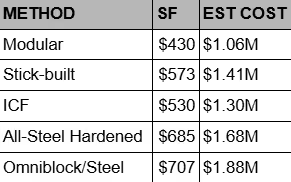
Very generally:
- Modular is the speed play
- Stick-built is the base value play
- ICF is value plus resilience
- Concrete and Omniblock/Steel are premium resilience
- All-Steel Hardened is maximum hardened
Post-fire demand and local labor conditions can move these numbers, especially for starts in busy seasons. Steel and concrete markets are also affected by tariffs, fuel costs, and global demand.
Separately from your main budget, it is wise to carry at least 10 to 15 percent escalation on steel-intensive systems like All-Steel Hardened and Omniblock/Steel, given recent structural steel and rebar price volatility. Your contractor and design team can help you align this contingency with current bids and supplier data at the time you sign a contract.
Altadena properties may also face requirements such as undergrounding of utilities in certain conditions, which can add in the range of $20,000 to $40,000 per property, depending on agency direction and utility coordination. This is not usually included in basic estimates. Confirm specific requirements with Los Angeles County agencies and your utility providers before you finalize your soft cost plan.
Across all systems, remember that these hard costs do not include soft costs. A realistic wildfire home rebuild in Los Angeles usually needs another $200,000 to $350,000 or more in design, engineering, permits, reports, and owner-selected items before you have a complete picture. Building in a buffer where you can help reduce stress later, when decisions start to stack up quickly.
FAQs on Los Angeles Fire Rebuild Methods and Costs
Cheapest Way to Rebuild a Fire-Damaged Home in Los Angeles?
After a total loss, it is understandable to focus first on what is financially possible. For many Los Angeles fire rebuilds, WUI-compliant stick-built framing is the lowest hard cost option among traditional, site-built systems, at around $1.41 million or roughly $573 per square foot for a home in the 2,455 square foot range. To meet code in a fire zone, that wood structure must be upgraded with noncombustible roofing, ignition-resistant siding, ember-resistant vents, and tempered glazing. Modular construction can come in with lower hard costs per square foot and shorter schedules, but site work, utilities, craning, and foundations still matter. The most affordable path is specific to your lot, access, soil conditions, and how your insurance and personal funds line up with both hard and soft costs.
How Long Does It Take to Rebuild After Altadena Wildfires?
Timelines are a major source of stress after a fire, especially when ALE benefits are limited. For most site-built methods, including stick-built, ICF, Omniblock/Steel, and All-Steel Hardened, a realistic range is roughly 12 to 18 months from the start of construction to move-in. This does not include upfront time for design, surveys, engineering, and permits, which can add several months depending on Los Angeles County or City workloads and how quickly you are able to make decisions. Modular systems can often shorten the primary construction window to around 7 to 10 months because much of the work happens in a factory while foundations and site work proceed in parallel. Your exact timeline will depend on permitting pace, utility coordination, inspections, change orders, and any insurance approval steps tied to funding.
Is Modular Construction a Good Option for an LA Fire Rebuild?
For some families, modular is a practical way to get home sooner. Factory-built modules can reduce on-site time, help control certain labor costs, and deliver a predictable building shell, which can ease some of the uncertainty after a fire. Modular can be especially helpful when ALE benefits are approaching their limit and returning to your property quickly is a top priority. However, modular is not a universal solution. You need adequate street access and staging for trucks and cranes, and you usually have less freedom to customize layouts, spans, and roof forms. It is essential to understand exactly what the modular contract includes, such as finishes, fixtures, and mechanical systems, and what remains your responsibility, like foundations, utilities, retaining walls, driveways, and landscape restoration.
What Does WUI-Compliant Construction Mean in California Fire Zones?
When your home is in a mapped Wildland-Urban Interface (WUI) area, you are rebuilding where structures and wildland fuels meet or are close together. In California, WUI-compliant construction is required in designated fire-severity zones to slow fire spread and reduce ember intrusion. Common requirements include Class A fire-rated roofing, noncombustible or ignition-resistant siding, ember-resistant attic and foundation vents, tempered glass at certain openings, and careful detailing at eaves, decks, and underfloor areas. These rules apply regardless of structural system, so both stick-built and ICF homes must meet the same baseline. While WUI construction increases cost, it also significantly improves the chances that a home can survive ember storms and radiant heat during a wildfire, which many homeowners have seen firsthand in recent fire seasons.
How Do Steel Price Changes Affect Fire Rebuild Costs in Los Angeles?
Steel and rebar are key materials in many hardened systems, including All-Steel Hardened, Omniblock/Steel, and some ICF assemblies. In recent years, global demand, transportation costs, and U.S. trade policies have combined to keep structural steel prices higher and more volatile than in earlier building cycles. When you are planning a home rebuild in Los Angeles that relies heavily on steel, it is wise to carry a dedicated escalation allowance, often at least 10 to 15 percent on the structural steel and rebar portions of the work. Your contractor can help you interpret current mill pricing, tariff impacts, and lead times at the time you are bidding. This does not mean you should avoid steel, but it does mean your budget needs a realistic buffer for market shifts that are outside your control.
What Is ICF Construction, and Is It Good for CA Fire Zones?
ICF (insulated concrete forms) systems use hollow foam blocks or panels that are stacked, reinforced with rebar, and filled with concrete, creating a solid wall wrapped in continuous insulation. Under standard testing, these walls typically carry multi-hour fire ratings, and they also perform well for energy efficiency and sound control. In designated fire zones, that inherent fire resistance, combined with WUI-compliant detailing at roofs, windows, and vents, creates a strong envelope against heat and embers. Costs for ICF in the Los Angeles region can be similar to, or slightly higher than, fully hardened stick-built assemblies, but with better thermal performance and durability. For homeowners balancing budget, resilience, and comfort, especially after living through a wildfire, ICF is often a strong, middle-ground option for a wildfire home rebuild in Los Angeles.
Get Started With Your Project Today
If you are ready to begin a thoughtful and resilient wildfire home rebuild in Los Angeles, our team at Letter Four is here to guide you through every step. We will help you clarify your vision, navigate local regulations, and integrate fire-conscious design from the start. Reach out today so we can discuss your property, timeline, and budget, and outline a plan that fits your needs. To schedule a consultation or ask questions, simply contact us.
Sources
• California Department of Insurance, Wildfire insurance guidance and policy updates.
• County of Los Angeles Department of Regional Planning, Fire hazard severity zones and WUI mapping.
• Los Angeles County Department of Public Works, Building and safety permit processes and timelines.
• City of Los Angeles Department of Building and Safety, Permitting and WUI-related code information.
• LAist and similar local outlets for reporting on post-fire rebuild experiences, construction costs, and insurance trends in Los Angeles County.
.png)
.avif)

.svg)

















.avif)